Well, hello, hurricane season, wherever have you been these last eight months? The folks at the National Oceanic and Atmospheric Administration predict the coming season will be a less severe than average, but I say predicting the weather is much like predicting the stock market. Yes, do plan a picnic, but take an umbrella and some cash.
Forecasts, Storms, and Market Noise
As to any potential hurricane in the offing, please bring the rain, but hold the winds. We’ve had enough storm surges and flying roofs in the southeastern USA for a while. A long while.
I have a brother who tracks earthquakes, volcanoes, and cataclysmic weather events. He says those things are probably increasing, but it is very hard to tell. The data from long ago is suspect … and the reports today are just as suspect, but for different reasons. Then there is the issue of time frames and patterns within larger patterns. When I hear people on the radio talk about whether we are in a cyclical or secular market, I change the channel. Predictions, for the most part, are a lot of noise in the system.
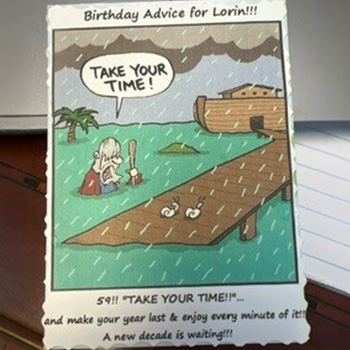 Before I leave today’s weather discussion and predictions from NOAA (this is a witticism you will need to refer to in a few seconds), I want to show you the birthday card I received ten years ago. It still sits on my desk and continues to amuse me.
Waiting for the Weather to Change
Waiting for the weather to change, snails to cross the finish line, and the stock market to hit some arbitrary level is not a task for the impatient.
On another totally irrelevant note, I heard Jim Gaffigan on Sirius Radio as I drove to work this morning. “Raising children is a lot like being a tourist”, he said. “You walk around noisy, crowded places, spending money you don’t have, looking for a bathroom.” Is that a great life observation or what? I wonder if he also predicts markets and weather.
So here I am, in charge at the White House. No, wait. That was Alexander Haig. As for me, I am wandering through life, rain or shine. I had a neighbor who would put off any yard work during the summers when the threat of thunderstorms was always present. He would sit in a folding chair in his garage waiting to see if it was going to rain (with anticipated lightning). Once it did begin to rain, he would go inside and sit in his recliner and wait to see if it was going to stop. No, he never did get much accomplished in the yard. Probably not anywhere else, either.
Preparation, Not Prediction
I listened to a podcast this morning featuring Ben Carlson, Director of Ritholtz Wealth Management. One segment of his talk was titled “Understanding Market History is About Preparation, Not Prediction.” Shoot, I felt like I didn’t need to listen to the podcast at all. There was enough wisdom in that paragraph title to sustain me for a couple of weeks of contemplation!
Why Market Timing Falls Short
All of us had heard it said a jillion times or more: “You can’t time the market.” My problem, however, has been that I had a hard time accepting that. With the sophistication of our best minds in mathematics, game theory, and computational power, surely, we can build an algorithm to create a reliable (enough) prediction model. Right?
Wrong.
We can’t and don’t call me Shirley. Maybe somebody out there has built that algorithm (never say never, right?), but their name would surely be listed atop the “richest cats in the world” list, and I haven’t seen any suspects yet. Nope, timing the market is a fool’s errand, and I have proved it to myself by acting the fool in a smallish personal account for the last decade. Every so often, I need to remind myself that I am a dope.
Lessons From Decades of Investing
I have been investing in the stock and bond markets for about 45 years now. My first ten years of investing consisted of putting small amounts of money into a 401(k) and investing it in whatever fund(s) the other computer nerds around the lunch table said was best. Looking back, I’d bet dollars to donuts they were looking at nothing but one-year trailing returns and making their selections based on that. This is how entire engineering departments found themselves invested in “Latin American XYZ Fund” or some such thing that had one stellar year in the entire life of the fund. That year being, of course, the year before the lunch bunch piled our money in.
You and I probably remember the economic struggles of either our parents or our own young selves as we reaped the pain of the excessive inflation of the 70s. That was a tough decade. Life didn’t change until monetary policy changed and Ronald Regan nominated Paul Volcker to chair the Federal Reserve. Mr. Volcker stands alongside Milton Freidman and Art Laffer as the giants who led me through the wilderness of economics and personal finance. Some may disagree with their economic philosophies, but some people are wrong a lot of the time. I heard Neil Dutta on a recent podcast say, “It’s not a problem to be wrong at times, it’s a problem to keep being wrong over and over again on the same side of the argument.” I liked that thought a lot.
 Staying the Course Through Bear Markets
 Staying the Course Through Bear Markets
Be the investing pragmatists we are, we know about bear markets. We lived through Black Monday in 1987, the “dot com” bubble in the 2000s, the “Financial Crisis” or “Great Recession” in 2008, and then the inflation of 2022. They were very painful at times, but in hindsight, they were blips in the long haul to where we are today for people who stayed the course.
Before I leave behind the similarities between weather predictions and stock market predictions, I’ll tell you that my wife obsesses over when and if it is going to rain. I maintain that I cannot accurately predict the rain until I see it coming across the lake. Guess who worries less and nails the predictions more often? The same husband who has finally learned not to say, “I told you so.”
This mirrors the two great advantages of accepting that one cannot predict stock market moves with even a tiny bit of accuracy. The first benefit is that most investors (regulations won’t let me assert “all investors” because it’s not provable) will do much better over the long term if they don’t try market timing. The second, and sometimes better, benefit is that we no longer have to think about stock market levels at all, except for benign interest.
A Plan for Rainy Days
What are my buy and sell signals, you ask? I buy when I have the money and sell when I need the money. And I do try to anticipate when I might need the money, because I have happily given up trying to predict when the next bear market will show up on my computer screen. I am thoroughly amused that I, a guy who had almost no use for a bond when I was fifty years old, now find that short-term Treasury Notes are some of my best friends! It’s good to have a plan, isn’t it?
There you have it, and I know I sound like a broken record, but it helps us to remember the past as we move ahead. Perhaps you were like I was when I began my investing journey: a lack of knowledge, some overconfidence, general hubris, a tendency to worry, and a belief in my ability to predict outcomes. None of these has a place in our investing lives … or any other aspect of our lives, come to think of it. It’s good to have the knowledge and humility that life brings, but man, oh man, I don’t want to travel the old road again.
Pack the Umbrella Before the Storm
So forget the predictions. Pack a raincoat AND an umbrella. Tolerate a little rain, but get away from the lightning. Buy some homeowners’ insurance and a generator before hurricane season. And have enough cash in your investments to rest easy.
PS: And fer cryin out loud, tell your kids NOT to put private investments in their 401(k).
PPS: Today’s word is aberrate
I know the noun version, but I don’t think I have ever used it as a verb or adjective. Who knew?
June 2026
The opinions voiced in this material are for general information only and are not intended to provide specific advice or recommendations for any individual. All performance referenced is historical and is no guarantee of future results. The economic forecasts set forth in this material may not develop as predicted and there can be no guarantee that strategies promoted will be successful.